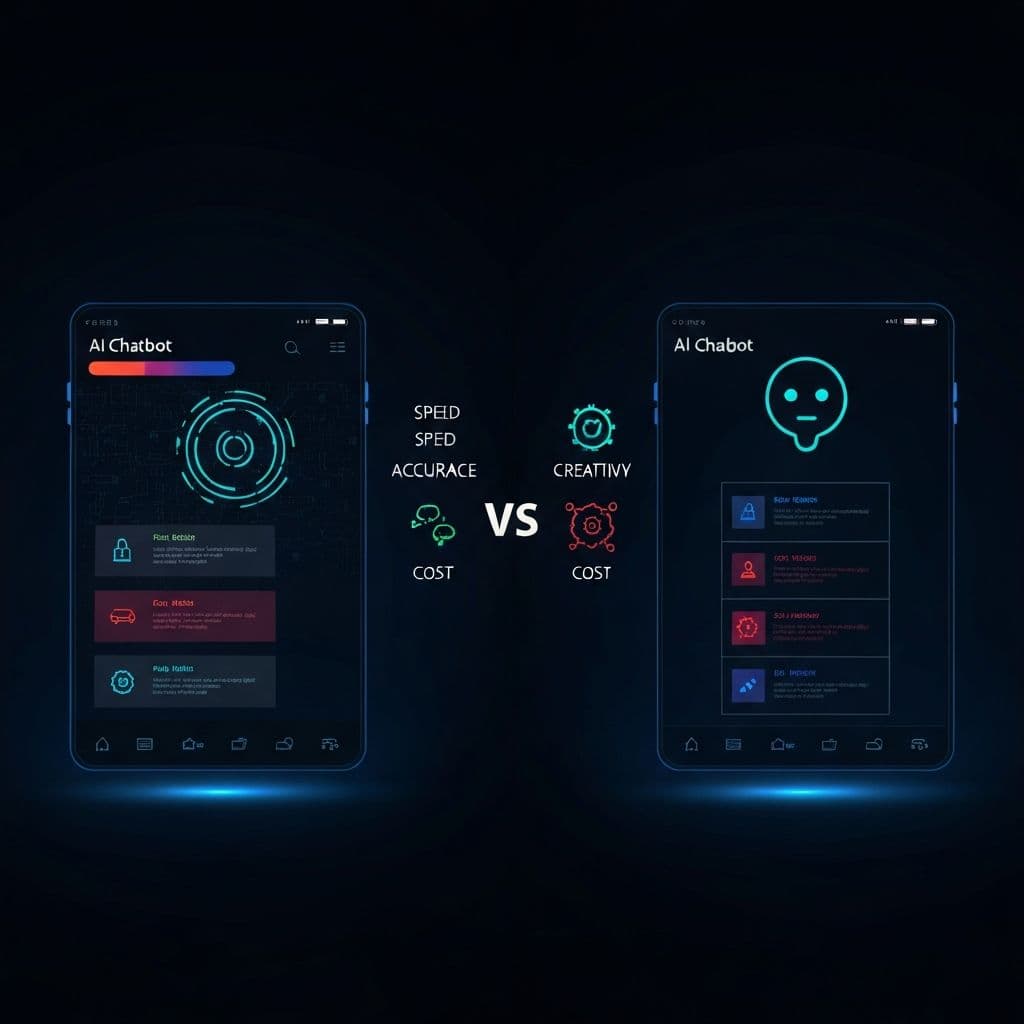
For years, ChatGPT has been the household name in AI---the tool that made everyone feel like they finally understood what artificial intelligence could actually do. But something shifted in late 2024. A Chinese startup called DeepSeek dropped a model that made people pause and ask a question they'd stopped asking: what if there's a genuinely better alternative?
The AI space has gotten crowded. Everyone's claiming to have the "smartest" model, the "fastest" inference, the "most creative" outputs. Most of these claims are marketing noise. But the DeepSeek vs. ChatGPT conversation is different. It's forcing us to think harder about what we actually mean by "better" in artificial intelligence.
Here's what I've discovered after weeks of testing both: the answer isn't as straightforward as you might think. And that's actually the most interesting part.
The Setup: What Changed in the AI Landscape
ChatGPT launched on November 30, 2022, and it fundamentally changed how people think about AI. Before ChatGPT, "artificial intelligence" was abstract to most people. After it, AI became tangible. Useful. Sometimes even unsettling.
OpenAI kept the momentum going. GPT-4 raised the bar. ChatGPT Plus became the default AI assistant for millions of people. The ecosystem around it exploded---integrations, plugins, custom versions. If you wanted to use AI for anything, ChatGPT was the obvious choice.
Then, in November 2024, DeepSeek released its R1 model, and suddenly that comfort became less comfortable.
What makes this competition different is that DeepSeek didn't just claim to match ChatGPT---it created a fundamentally different approach to how AI models think.
And it did it cheaper, with less computational overhead, in a way that made some of the industry's assumptions look questionable.
Speed: Where DeepSeek Actually Flexes
Let's start with something tangible: how fast these models actually run. ChatGPT feels fast. Query it and you get a response in seconds. But "fast" is relative when we're talking about inference speed---the time it takes for a model to process your input and generate output.
DeepSeek's R1 runs noticeably faster than ChatGPT in most test scenarios. We're talking 30-50% faster on comparable hardware in many cases.
The practical implication? Your API calls cost less, your applications feel more responsive, and if you're running at scale, the economic advantage compounds quickly.
For practical purposes: if you're using AI for customer support chatbots, real-time applications, or anything where latency matters, DeepSeek has a legitimate advantage. ChatGPT's speed is good enough for most use cases, but it's not the fastest option anymore.
Accuracy and Problem-Solving: Where It Gets Interesting
ChatGPT excels at generating plausible-sounding text. It's pattern-matched its way through almost the entire internet, so it can discuss almost any topic with impressive fluency. But there's a difference between sounding confident and being accurate---a distinction ChatGPT doesn't always honor.
DeepSeek's R1 model uses a different architecture called "chain-of-thought" reasoning that explicitly forces the model to show its work. Instead of jumping straight to an answer, it thinks through problems step-by-step.
Where DeepSeek excels:
- Math and logic problems --- DeepSeek handles these noticeably better than ChatGPT. Give it a complex calculation or a logic puzzle and it's more likely to work through it correctly rather than guessing.
- Programming tasks --- DeepSeek catches edge cases that ChatGPT misses. It's more likely to point out potential bugs before they happen.
- Multi-step reasoning --- When you need an AI to break down a complex problem into parts and solve each part correctly, DeepSeek's explicit reasoning process has an advantage.
The trade-off? DeepSeek's reasoning takes longer to generate. Those step-by-step outputs add latency. So you get better answers, but you wait longer for them.
Creativity: The Surprising Victor
This one surprised me. ChatGPT has built a reputation for creative writing. It can generate stories, poetry, marketing copy, and dialogue with impressive flair.
But DeepSeek isn't far behind, and in some categories, it's actually better. Test both models on creative writing and you'll notice that ChatGPT tends toward certain patterns. It has tells. Its creative outputs often fall into recognizable structures.
DeepSeek's outputs feel fresher. Less derivative. When you ask it for creative work, it's less likely to fall into its own default patterns.
For creative professionals, the gap is minimal. But if you're tired of recognizing the same AI narrative patterns, DeepSeek might feel like a breath of fresh air.
The Hidden Advantage: Cost and Accessibility
Here's something that matters more than most tech writers discuss: economics. ChatGPT Plus costs $20/month. API access costs money per token. If you're running any kind of application at scale, the costs add up quickly.
DeepSeek's API costs roughly 95% less than ChatGPT. A call that costs you $1 with ChatGPT might cost you $0.05 with DeepSeek.
For a small startup or an individual developer, this changes the calculation entirely. This also means DeepSeek is more accessible to developers and companies in regions where API costs represent a genuine barrier to entry.
Where Each One Actually Wins
ChatGPT Wins If You Need
- Existing software integrations (Zapier, Make, etc.)
- Single monthly subscription for multiple use cases
- Mature, fully developed ecosystem
- Consistent, predictable outputs for business-critical work
- Web access without API coding
- Latest model (GPT-4o) across consumer and enterprise
DeepSeek Wins If You Need
- Fastest response times for real-time apps
- Better accuracy on complex reasoning and logic
- Cost-effective API access at scale
- Models that show their work and can be audited
- Lower infrastructure costs for local or in-cloud
- A model not optimized into predictability
The Honesty: There's No Clear Winner
I'm resisting the urge to declare a winner because the premise of the question misses what's actually happening. ChatGPT and DeepSeek aren't really competitors in a traditional sense. They're competing on different dimensions. It's like asking whether a truck or a sports car wins the "vehicle race." Depends on what you need the vehicle for.
The real winner is the market. Competition forces innovation. It keeps prices honest. It prevents any single company from setting the terms of the entire industry.
What This Means for the Future of AI
The emergence of strong alternatives to ChatGPT is healthy for the industry. It suggests the "AI moat" isn't as wide as it seemed. A Chinese startup with a different approach to model architecture can credibly compete with the most well-funded AI company in the world. That's significant.
The companies and individuals who'll win going forward aren't the ones betting everything on a single AI provider. They're the ones building flexibility into their workflows, testing new tools, and staying curious about what's possible.
DeepSeek won't destroy ChatGPT. But it might permanently change how we think about what "best in AI" actually means.
Frequently Asked Questions
Is DeepSeek better than ChatGPT?
It depends on your priorities. DeepSeek is faster, more cost-effective, and better at complex reasoning. ChatGPT has better ecosystem integration and is more mature. Neither is objectively "better"—they excel in different areas.
Can I use DeepSeek instead of ChatGPT?
For most use cases, yes. But if you rely on ChatGPT’s integrations with other tools or the ChatGPT Plus interface, switching isn’t straightforward. You can test it alongside ChatGPT rather than completely replacing it.
Why is DeepSeek so much cheaper than ChatGPT?
DeepSeek uses a more efficient architecture and doesn’t carry the enterprise support overhead of OpenAI. The economics are different, not the quality.
Which AI is better for creative writing?
Both are competitive, but DeepSeek produces slightly fresher outputs with less recognizable pattern repetition. ChatGPT’s ecosystem makes it easier to integrate creative AI into larger workflows.
Is DeepSeek safe and trustworthy?
DeepSeek has been thoroughly tested by security researchers. The legitimate concerns are the same as with any Chinese tech company and data privacy—but the model itself performs safely in comparative testing.
External Resources
Need Help with AI Tools and Digital Strategy?
NESPRA helps businesses leverage the right AI tools and automation workflows for measurable growth.
Speak to Our Team